
In this first blog we wanted to present some information that is very relevant to right now, as we are getting many queries regarding this issue. We all know that when the sun beats down in the summer and early autumn we love a bit of ‘al fresco dining’, and the kids love playing outside. We also accept that we share this environment with hundreds of different insect species; all of which play a vital role in nature and food production to varying degrees. Some are beautiful and fascinating to sit and watch, some are a bit creepy but just quietly go about their business, and most you wouldn’t even know are there.
And then there are wasps. They are important to the ecosystem and help your garden to look in top condition; but they are annoying, sometimes aggressive, and potentially even dangerous to your health. One or two buzzing around is not a problem and easy to manage. But certain conditions in your garden can mean that there are a lot more wasps than is comfortable. When you start seeing this many wasps your first thought is probably that there must be a nest somewhere. You may well discover a physical structure in a bush or tree, as in the picture below.
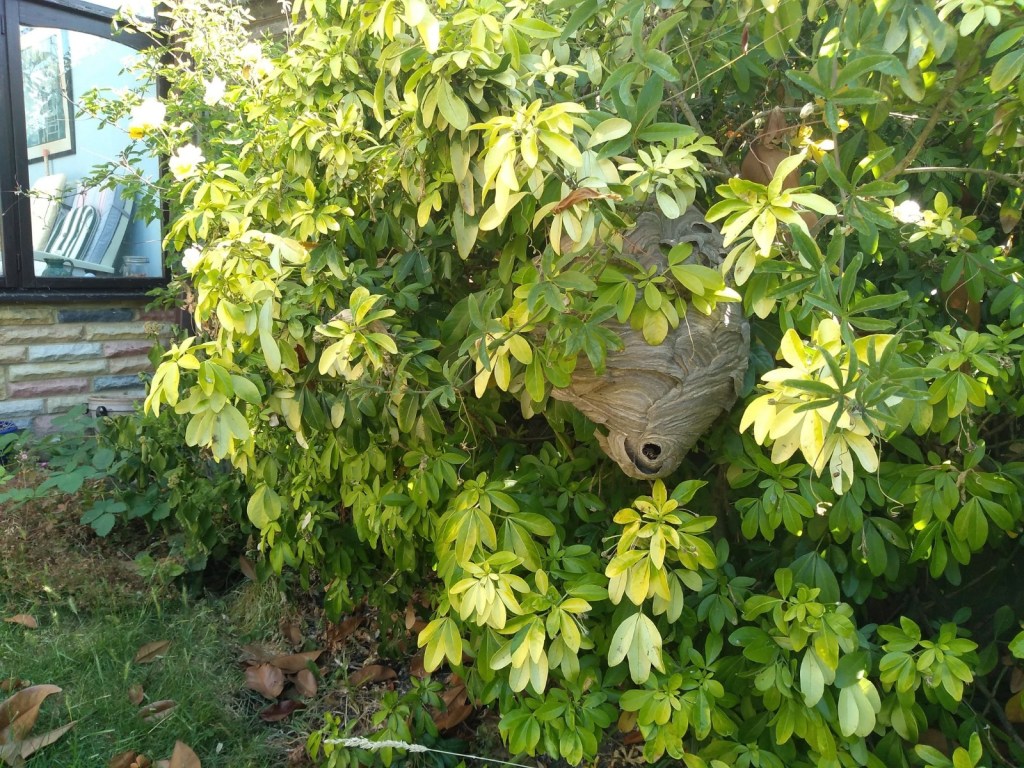
If you discover this in your garden, you only really have one option. Call a professional pest controller to remove it. I have heard too many horror stories of people that attempted to remove it themselves, and it didn’t end particularly well. Remember, one sting will hurt a bit but not do too much damage. Thirty stings in the space of seconds can put you in anaphylactic shock, potentially even killing you.
If you are unsure whether the wasp activity indicates the presence of a nest or not, just watch their behaviour briefly. If they are all grouped around a particular bush, flying from one leaf or flower to another; or even just sitting on a leaf not moving for a while, these are just foraging. This does not indicate a nest, even if they are in great numbers. On the other hand if you are seeing wasps constantly and purposefully flying directly in and out of a specific point, like a gap between branches or a hole in the ground, this is almost certainly a nest. It almost looks like a ‘wasp airport’; they wait for each other to land and take off.
So a confirmed discovery of a wasp nest gives you a simple solution. To call in the professionals. But supposing there is no nest, and you are concerned about the amount of wasps and the dangers associated? The solution to this is not quite as straight forward and requires some knowledge of why they are there in the first place. You should understand that you won’t eradicate all wasps from your garden for good, but you can help to cut the numbers down to a comfortable level or contain them to a certain area. Besides, wasps are as important to us as any other insect.
Wasps feed on the pests that infest garden plants and flowers, such as aphids, green fly and black fly. They collect the honeydew from the leaves, which is a sweet, sticky substance secreted by the aphids and other insects. They are also attracted to the sweet nectar that certain flowers give off, making the wasps not only useful for natural pest control in your garden, but also important for pollination. It only takes one scout wasp to venture from a group of foragers to explore the area; get attracted to your BBQ, send signals to indicate that they’ve discovered something nice, and within minutes the pesky creatures are all over your food and drink.
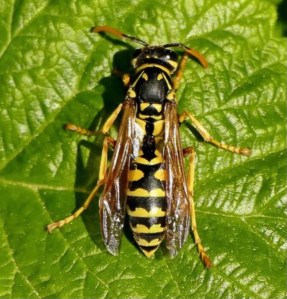
So the trick is to keep the wasps over in the plants and flowers away from your eating area. They shouldn’t bother you unless you go jumping into the plants, right? Technically yes, but some gardens are small and they might still be near your drinks, or near to the kids play area.
Can you just spray the plants with an insecticide to kill them?
This is what I am often asked. With an appropriate garden pest spray you may initially kill the aphids on a plant, which is one of the attractants for wasps, but those insects are likely to come back again at some point. Also remember that wasps are attracted to the nectar of certain flowers as well, so removing just one food source is unlikely to get you results. The most important issue with using insecticidal sprays (of the toxic, synthetic chemical variety) is clearly the environmental impact. These sprays don’t just target wasps alone, they also have a detrimental impact on all non target species in that area as well. Bees, butterflies and all other vital pollinators included. There is also the possibility of secondary poisoning to birds and other animals that prey on these insects.
There are naturally derived non-toxic sprays that are safer than the toxic equivalent as they have no long lasting residual effect. However that means they only work on immediate contact with the target insect so good luck trying to pop off every individual wasp that comes into the area, you’ll be there a while! A blanket spray all over the plant even with a natural spray is a bad idea as this will still harm other insects, such as bees.
Your best solution for keeping wasps at bay is a combination of hanging wasp trap containers in strategic positions, and some general housekeeping (or ‘garden keeping’).
Wasp Traps
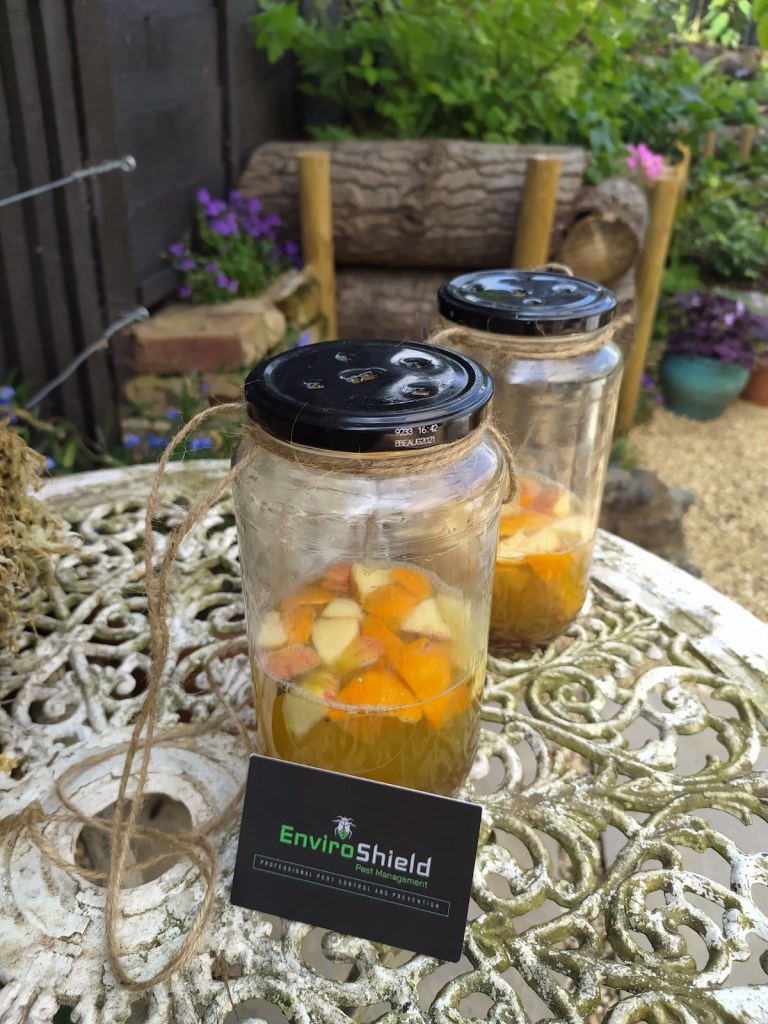
These traps, if made correctly, are highly attractive to the wasps that are already foraging on the plants in your garden, but won’t bring them in from miles around. And if placed in the right areas should keep them away from where you least want them. There are actually several plus points in using these traps and why we, as a responsible pest control company, recommend using them.
First of all they will only attract wasps and not bees, because of the solution you use. Bees are only really interested in the pollen of flowers whereas wasps are attracted to rotting fruit, beer, cider, fizzy soft drinks and protein based foods such as meat. So it’s a bit of a misconception that it’s only sugary food and drinks that attract them. Though in spring/summer the more sugary items are probably more effective and in the autumn the meat works very effectively.
Secondly they are also environmentally friendly, and financially friendly, if you go down the route of making homemade traps out of recycled household items. At EnviroShield we use homemade traps. Avoid buying traps from shops or online as they are unnecessarily expensive, made out of plastic and are probably shipped from overseas. Instead, use old glass jars or even old drinks bottles. I like to use large glass jars (that I think originally stored olives) as these are good sized jars to work with. Smaller jam jars will get full of dead wasps quicker and need emptying more regularly. The advantage of using glass jars over plastic bottles is that they need less modifying and also you can continue to use the screw cap, making them straight forward to empty and refill with new attractant fluid.
To make the trap, simply punch holes through the lid that are big enough for a wasp to climb inside. I used a hammer and screwdriver to punch through the holes but you can use a drill if needed. The wasps shouldn’t work out how to get back out of the holes but to make it even trickier rub a rag soaked in cooking oil around the inside of the jar at the top to stop the wasps being able to climb back up. Now once you fill about a third of the trap with attractant solution put the lid on and make a sling around the neck of the jar with string or wire so that you can hang it up.
What I use in the solution: old pieces of orange, orange peel and apple, beer, couple of teaspoons of sugar and a small drop of washing up liquid (this makes it difficult for the wasps to get out of the solution once inside). Towards the end of summer I’ll likely switch to beer with lumps of meat, such as sandwich ham or bits of chicken, and the drop of washing up liquid.
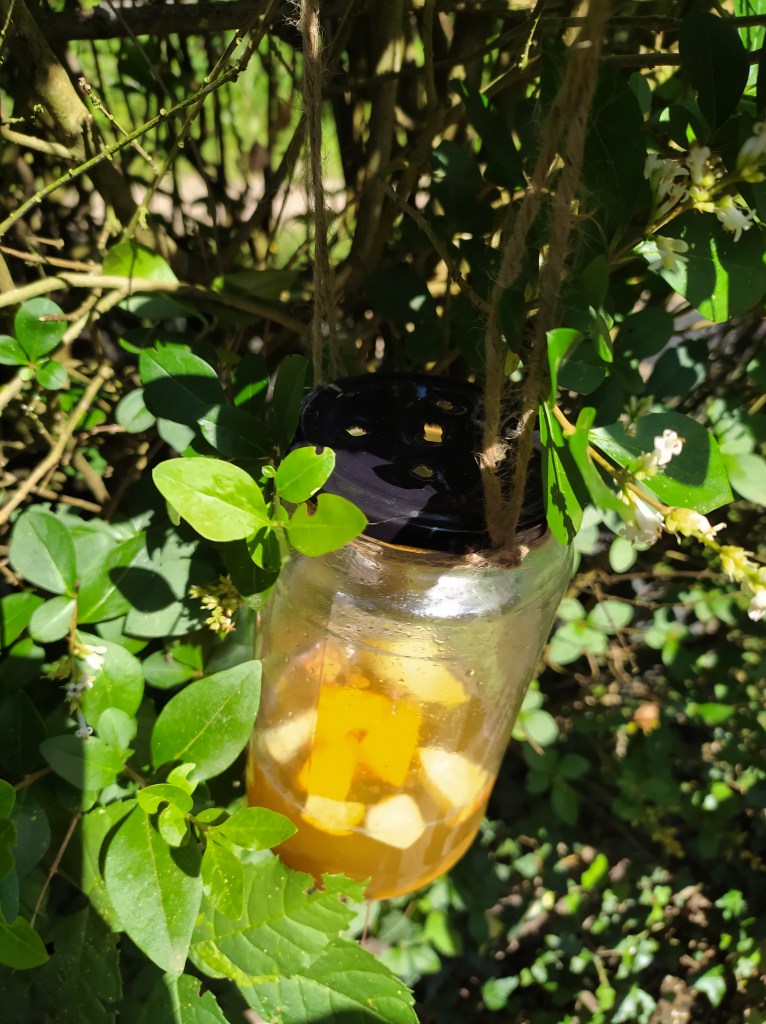
Place the traps in and around the plants and trees that the wasps are foraging on, or at least as far away from your dining area as possible. The idea is to trap them before they come near you, so if you hang them over your table and chairs you are just inviting them over. So there you have it, effective traps that are simple to make and can be reused over and over again.
What else can be done?
Alongside the traps these simple housekeeping tips will help with reducing wasp numbers in your garden:
- Keep food and drink covered when not being consumed.
- Used plates, glasses and packaging taken inside.
- Pick up fruit fallen from trees before it starts to rot.
- Keep lids secure on bins and composters, ideally these would be away from eating and playing areas anyway.
- Plan your garden so that you have flowers and wasp attractive plants away from the eating area and have fragrant herbs such as wormwood, spearmint and thyme bordering the patio as these are good wasp deterrents.
If you try all these tips then you stand a good chance of not being bothered by wasps when you’re in your garden. Remember though wasps are important, and avoid using sprays at all costs. This advice is to help control foraging wasps, not to harm other insects.
And if you think you have a nest, that’s what we are here for! Call or email now for an affordable and effective treatment.
 EnviroShield Pest Management - Bishops Stortford